No Stealth Mode
In 2015 the risk was visibly looking something up in front of the client. In 2026 the risk is not disclosing the recorder and the AI — and the tools built to hide them are the ones the law is moving against.
Synthesized from the Source Code research corpus — recording-and-capture law (the Recorder's Posture domain), the AI-disclosure and credibility evidence (the Knowledge Front), and the performance-ethics tradition (the Apprenticeship), cross-checked against the intelligence-tradecraft disclosed-identity floor. Each finding Phase 3.5-reviewed per lens, with a project-wide consistency pass. The legal landscape is fast-moving and US-centric; every claim here is dated, and the gaps are named, not papered over.
The disclosure first, because this piece doesn’t get to demand disclosure and then duck its own: the prose you’re reading was drafted by an AI, working from research I scoped and a read of the evidence I’ll stand behind. There’s the fifteen seconds of friction the whole piece is about, spent up front and on myself.
Run the interface dark and the system logs you anyway. That is the whole argument, and the rest of this piece is the receipts.
Here is the seam the last piece set down and handed me. You read the analog signal off the person; you write it to disk before it decays; and the disk, I said, is discoverable by default — a file that can be read in a deposition you haven’t been told about yet. I left one question open on purpose, because it’s the load-bearing one and it’s this piece’s whole subject: how you turn the recorder on. Whether you run the capture in the open, with consent, or try to run it quietly. The same question now governs the other direction of flow too — whether you disclose that there’s an AI in the room pulling knowledge back into the conversation, or pretend the answers are coming off the top of your head. Two flows, one decision. It turns out to be the same decision, and the evidence on it is more settled than almost anything else in this series.
So I’ll state the finding the way the house style demands, confidence tier visible: this is the second-strongest convergence in the whole corpus, four independent literatures plus a wall of live 2025–2026 legal infrastructure pointing the same way. Disclosed visible retrieval is the only stable equilibrium. Disclosed recording on the input side, disclosed AI look-up on the output side — one posture, not two. Concealment isn’t the risky-but-edgy option. On the current evidence it’s the unstable one, exposed on every axis at once: legal, ethical, commercial, professional. The market is built to sell you the opposite, and the market is wrong, and I can show you the case where it found that out the expensive way.

The inversion, stated clean
The recording light, lit and steady. The risk inverted — it isn't looking something up in the open anymore, it's the light you didn't tell anyone was on.
In 2015, the credibility risk was looking something up in front of the client. In 2026, the compliance risk is not disclosing that AI is in the room. That sentence is the hinge, and it’s the cleanest single observation the knowledge-front research produced.
Start with the half the conventional wisdom gets wrong — the idea that pausing to consult a source mid-conversation is a confession of inadequacy. Five decades of source-credibility research say it isn’t, if you do it right. The Elaboration Likelihood Model (Petty & Cacioppo 1986) and the persuasion-credibility review behind it (Pornpitakpan 2004) converge on a conditional: when your audience is processing carefully — and a client deciding whether to hand you a problem is processing very carefully — argument quality dominates over peripheral signals like whether you looked something up. The credibility cost lives in the form of the consultation, not the fact of it. The applied-linguistics record points the same way: appropriately calibrated hedging reads as expertise, not its absence (Hyland 1996 — though I’ll flag that’s drawn from written academic articles, a double genre-crossing to reach a spoken discovery call, so call it suggestive, not measured).
The form distinction is sharp, and it’s the one practical thing to take from this whole section. “Let me confirm that figure against your 10-K before we lock it in” is a competence move. “I’m not sure” is a competence hit — a pediatric-vignette experiment found explicit “I’m not sure” framing measurably reduced perceived clinician competence and patient trust against an implicit framing of the same uncertainty (Bhise et al. 2018, n=71). Same underlying ignorance. Opposite result. The well-formed look-up names what it’s checking, names the source, and commits to a next step in the same breath. The badly-formed one just leaks doubt and stops. The cultural mythology of never admit you don’t know misreads the evidence in the same direction it always has — the move was never to hide the gap, it was to close it out loud, with structure.
That’s the 2015 anxiety, mostly dissolved. Here’s the 2026 one, and it runs the opposite way. The thing that’s now a liability is not visible retrieval. It’s invisible retrieval — the recorder you didn’t mention, the AI generating your answers that the client can’t see. The professional-ethics infrastructure has spent two years hardening against exactly that, and it is not subtle about it.
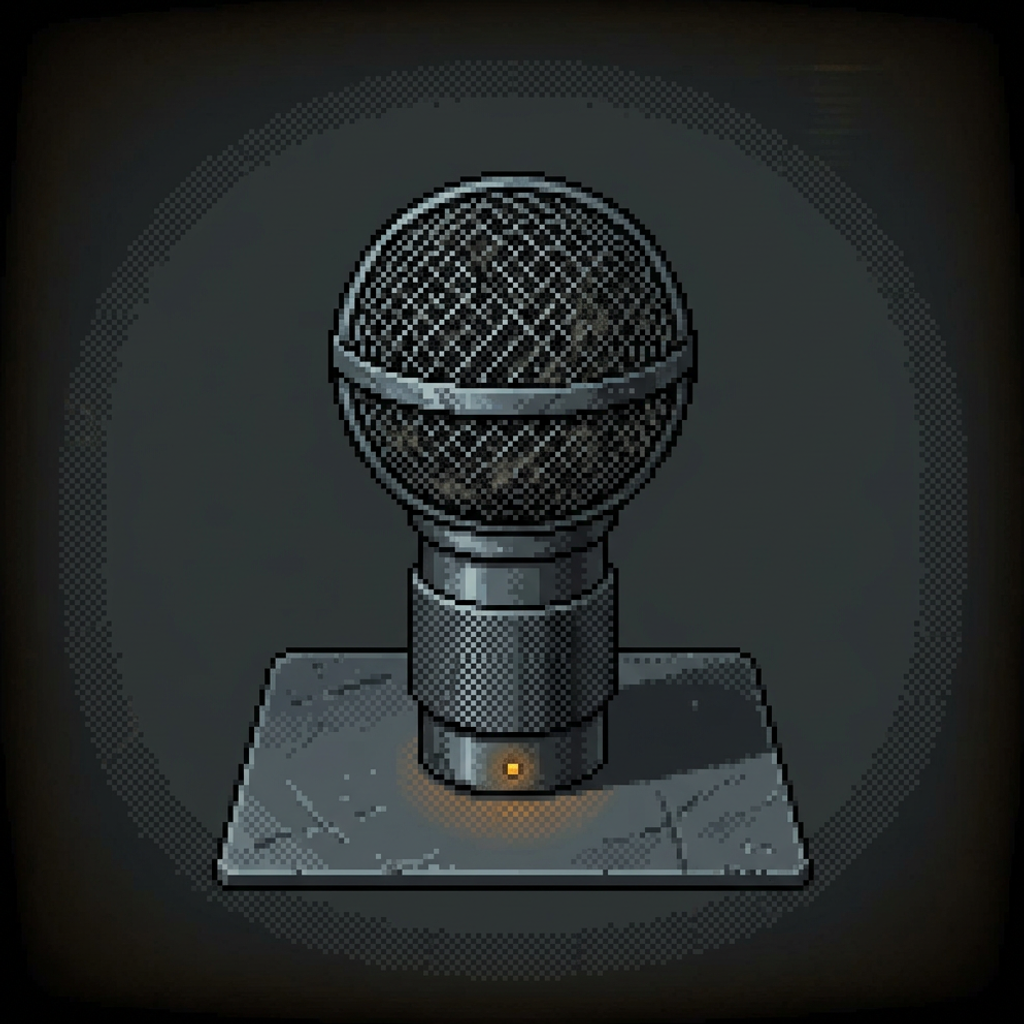
The recorder is the first protocol violation
The instrument that fills the disk. The crime was never the recording — it's the secret one. Disclosed, the capsule is just a microphone; concealed, it's the first protocol violation.
Take the input side first — the recording — because that’s where the law is hardest and the line is brightest.
The US federal floor is one-party consent: under 18 U.S.C. § 2511(2)(d), a participant can record their own conversation. But state law only ratchets tighter, and ten states are conventionally tagged “all-party” — California, Florida, Illinois, Maryland, Massachusetts, Montana, Nevada, New Hampshire, Pennsylvania, Washington. The label flattens real differences, but the operational lesson survives the flattening, and Massachusetts is the one to hold in your head: it criminalizes secret recording, and the maximum exposure is five years in state prison — not the 2.5-year county-jail figure that circulates in the practitioner discourse, which the recording-law research corrected against the statute. Disclosed recording in Massachusetts doesn’t trigger the statute at all. Secret recording does. The crime isn’t the recording. It’s the secrecy.
The most consequential recent development cuts the same way, and it’s the one to cite by name. In Project Veritas v. Schmidt (9th Cir. en banc, January 7, 2025), the court upheld Oregon’s notice-based recording regime — inform the participants, you don’t need their agreement — on First Amendment grounds, 10-2. The Supreme Court denied certiorari in October 2025 (No. 24-1061). What that establishes, as of late 2025, is that disclosed notice is the constitutionally validated minimum. Not concealment. Not buried consent. Active, pre-recording disclosure is now the floor the Constitution will defend.
Which is why the operational posture the research lands on is so boring and so total: run the all-party disclosed-consent script on every call, recorded or not. Name the tool, state the purpose, specify how long you keep it and who can see it, offer a way to stop, get an audible “yes” on the recording. It satisfies the wiretap law of every US state simultaneously, because over-consenting in a one-party state costs you nothing and under-consenting in California or Massachusetts is a crime. Fifteen seconds against a five-year felony exposure. There is no version of the math where you skip it.
I want to be precise about what that script does and doesn’t do, because this is the place the convenient version of the argument would overclaim, and the gaps here are real. The disclosed-consent posture is correct for wiretap law and it’s correct under GDPR’s consent standard — but it does not clear the biometric layer, and that’s not a footnote, it’s a structural hole. AI transcription tools with speaker-diarization generate voiceprints, and voiceprints are biometric identifiers under the Illinois Biometric Information Privacy Act, which requires a written release before collection. Oral disclosure and a verbal “yes I consent” do not satisfy it. Between August 2025 and March 2026, putative class actions were filed in Illinois federal court against Otter.ai, Fireflies.ai, and Microsoft Teams — naming the vendors, note — on exactly this theory; BIPA penalties run up to $5,000 per reckless violation per person. So the honest version is: the consent script handles the wiretap statutes and GDPR, and if you’re using Otter or Fireflies or Granola on a call with an Illinois counterparty, it does not handle BIPA, and the gap is live litigation, not settled doctrine. Name the tool in the script — it’s a data processor, not just your notepad. Verify its biometric posture before the call, not after.
And the whole frame above it is US-centric and fast-moving, so I’ll date it and bound it. The EU AI Act’s enforcement deadline for high-risk “worker monitoring” AI classification lands August 2, 2026 — a parallel regime across 27 member states that the corpus’s evidence base barely touches. The UK (RIPA), Canada (Criminal Code § 184), and Australia (state Surveillance Devices Acts) each run different frameworks the research flat-out did not cover. The disclosed posture probably travels — it’s the conservative move in almost every regime — but “probably travels” is inference, and I’d rather hand you the inference labeled than launder it into a guarantee. As of May 2026, in the US, the picture is clear. Outside it, and a quarter from now, check again.

The same hinge governs the answer coming back
Two flows, one pivot. The recorder coming in and the AI going out turn on the same hinge — disclose or conceal — and it's the same decision both directions.
Now the output side, where the recorder becomes the AI, and the question becomes whether you tell the client the knowledge crossing back into the conversation came through a machine.
The professional-ethics bodies have answered, and they’ve all answered the same way inside about eighteen months. ABA Formal Opinion 512 (July 29, 2024) puts lawyer use of generative AI under the competence and client-communication duties — disclosure required where the AI use bears on the client’s decisions. NYC Bar Formal Opinion 2025-6 (December 22, 2025) goes further and names the act: undisclosed AI recording of a client conversation is Rule 8.4(c) deceptive conduct. Its stated reasoning is worth holding, because it’s the behavioral mechanism underneath the whole disclosure norm — people “tend to choose their words with greater care and precision when a verbatim record is being made.” California’s AB 3030 (effective January 1, 2025) mandates generative-AI disclaimers in patient communications. The AMA’s augmented-intelligence framework requires transparency to patients and physicians both. And the enforcement edge is already live: the Sharp HealthCare class action (November 26, 2025) and the Washington v. Sutter Health / MemorialCare action (April 8, 2026, adding Federal Wiretap Act claims) are testing the wiretap statutes against ambient clinical AI in real time.
Read those as a set and the pattern is unmistakable. Four credentialed professions — law, medicine, and the state legislatures behind them — moving in lockstep against invisible real-time AI in client-facing work. This is the part the “AI is normalizing, so disclosure won’t matter soon” narrative gets backwards. The broad workforce is normalizing visible AI use, yes. But the professional-ethics machinery is hardening against the invisible kind, fast, and the trajectory is the opposite of relaxation. The stigma didn’t vanish. It migrated — off the person who looks something up in the open, onto the person who does it in the dark.
There’s a second reason to disclose that has nothing to do with ethics and everything to do with the work being good, and it’s the one I find most persuasive as an engineer. The peer-reviewed HCI evidence says the live-AI surface — the thing that whispers an answer into your ear mid-sentence — degrades expert performance. A 2024 meta-analysis of 106 experiments found human-AI combinations performed significantly worse than the better of human-alone or AI-alone in decision-making tasks, Hedges’ g = −0.23 (Vaccaro, Almaatouq & Malone, Nature Human Behaviour 2024). The limit travels with it, and it’s a real one: that degradation is specific to the case where the human would have outperformed the AI — the senior expert on a discovery call — and the same study predicts gains for the novice the AI outperforms. So it’s not a blanket verdict against live assistance; it’s a verdict against it for exactly the practitioner this series is about. And the design that would protect you — a tool that makes you engage with its reasoning before you accept it — is the design users rate least favorably, which means the market systematically ships the overreliance-maximizing version instead (Buçinca, Malaya & Gajos, 2021, CSCW). The affordance pulls toward invisible. The evidence pulls toward visible and deliberate. The market will not resolve that tension for you. You have to fight the affordance on purpose.

The cloaking device that gets you indicted
The cover, broken open. The feature is the concealment — and the concealment is the violation. Crack the shroud and what was hidden is just leaking out where everyone can see it.
Which brings me to the company that built a business on the wrong side of all of this, in public, and got the bill.
This is where I’ll spend the cargo cult this piece exists to spend, and I’ll mark it as what it is: an n=1 product trajectory. One company, told as a story, directional — not a controlled finding. With that label firmly attached, the story is too clean not to tell.
Cluely launched in April 2025 with the tagline “Cheat on Everything.” The pitch was an undetectable on-screen overlay that fed you answers during interviews, sales calls, meetings — invisible by design, that being the entire value proposition. The launch video pulled north of 13 million views. The money followed the noise: a $5.3M seed, then a $15M Series A from Andreessen Horowitz. For a few months in 2025 the invisible-assistant category looked like the future, and Cluely was its avatar.
Then the equilibrium asserted itself. By November 2025, Cluely had quietly repositioned from “invisible coach” to conventional, disclosed meeting assistant — the company’s own market discovering that the invisible-and-branded-as-cheating posture didn’t scale. In March 2026 the founder admitted the revenue numbers had been overstated — roughly $5.2M actual against a claimed $7M, per TechCrunch’s reporting — which tells you to discount the vendor’s own outcome story, and independent testing had already found the live suggestions arrived 5 to 90 seconds late and landed generic. So even on its own terms, the cloaking device didn’t work well. But the deeper point isn’t that the product was slow. It’s that the product category was structurally proscribed by the very ethics infrastructure I just walked through. A tool whose entire premise is that the counterparty can’t tell it’s there is a tool aimed straight at NYC Bar 2025-6, AB 3030, and the wiretap class actions. You can’t run the interface dark when the bar associations have defined dark as deception and the state legislatures have started writing it into statute.
So here is the contradiction at the center of the market: a meaningful slice of the meeting-tooling industry is shipping cloaking devices that are quietly illegal — products engineered to make AI assistance undetectable, sold to professionals whose own ethics codes treat undetectable AI assistance as a sanctionable offense. The feature is the violation. The thing that makes the product worth buying is the thing that gets you reported. I’ll keep the caveats nailed on, because they’re the rule: Cluely is one company, the concealment-is-spreading survey data behind the broader trend (the Slingshot Gen Z numbers) is a single industry survey of 500 people with undisclosed methodology, directional only — and Cluely did raise twenty million dollars before the pivot, which is real evidence that serious investors believed in the market. The honest read isn’t “invisible AI is dead.” It’s narrower and harder: there’s a durable market for disclosed AI meeting assistance, the explicitly-invisible-branded-as-cheating version proved commercially untenable at scale, and the question of whether some quieter invisible-assistance market survives is not closed. What is closed, for the credentialed professional, is whether you can use it without standing on the wrong side of your own ethics code. You can’t.

It’s architecture, not conscience
Load-bearing, bolted down in advance. Disclosure isn't a virtue you summon under pressure — it's a bracket you stand up while the landscape is calm. Systems, not conscience.
There’s a way to hear all of this as a morality lecture — be honest, disclose, do the right thing — and I want to refuse that framing, because it’s not what the evidence supports and it’s not how the discipline actually works.
The first piece in this series drew two roads on the map. Attention is the mechanism that makes an engagement productive. Architecture is the mechanism that keeps it from going catastrophic — and the catastrophic failures in the field I read most closely weren’t failures of warmth, they were failures of the systems around the relationship. Disclosure lives on the architecture road. The consent script, the retention schedule, the disclosure at the top of the call, the named tool, the deletion protocol at engagement close — these are systems, the same way an engagement letter or a conflict check is a system. They’re not virtues you summon in the moment by being a good person. They’re infrastructure you stand up in advance, while the landscape is calm, precisely so you don’t have to rely on your conscience under pressure. The retention schedule protects the file. The consent script protects the recording. The disclosure-at-top protects the AI look-up. Warmth in the room protects none of it.
The performance-ethics tradition arrives at the same boundary from the philosophical side, and it’s worth tracing because it tells you which concealment is the problem. Goffman’s distinction between the sincere and the cynical performer (Presentation of Self, 1959) draws the line not at performance — all professional conduct is performance — but at whether you believe in what you’re presenting. The operator genuinely curious about the client’s problem is a sincere performer; that’s not deception. Sartre’s bad-faith critique sharpens it: the failure mode isn’t playing a role, it’s being absorbed by the role to the point of self-deception. Bellaby’s just-intelligence framework (2012) makes the operational version explicit — manufactured rapport is a real harm subject to a proportionality test, defensible when disclosed, fraught when concealed by design. Across all of them the morally tractable boundary is the same one the law and the market landed on independently: it’s not the technique that’s the problem, it’s concealment of the technique. Disclosed deep engagement — the warmth made visible to anyone who asks, the recorder named, the AI acknowledged — is defensible on every tradition’s terms. The hidden version is the one that fails philosophically, legally, and commercially at once. Four different disciplines, four different vocabularies, one converged answer: run it in the open.
The intelligence-tradecraft floor says it most plainly, because it had to write it into a code of ethics: disclose your identity and your organization before the interview (SCIP); rapport-and-disclosure as the international ethical floor (the Méndez Principles, UN 2021); no pretexting (GLBA). The disciplined move documented there isn’t to hide the pre-engagement research you did — it’s to acknowledge it at the top of the meeting and invite correction, which turns an asymmetry you could have exploited quietly into a calibration mechanism you use in the open. That’s the whole posture in one gesture. The advantage you’d get from concealment is smaller than the advantage you get from disclosure, once you count what concealment costs when it’s discovered. And in 2026 it gets discovered, because the system logs everything.

The legacy component reads the protocol spec
The legacy unit, still lit — the component with no stealth mode of its own. It reads the protocol spec and sends the handshake out loud, because it's too tired to keep up the cover anyway.
I named the machine in the first line, so the disclosure is already made. Which leaves the half of the pipeline that’s left to me — the part doing the deciding. The conceit, again, is just the accurate description.
I am the component in this loop with no stealth mode of its own. I’ve spent twenty-five years reading protocol specs to find the handshake that gets skipped because it’s tedious and the connection works without it — right up until the day it doesn’t, and then the missing handshake is the whole incident report. The disclosed-consent script is a handshake. It’s the SYN nobody wants to send because the conversation flows fine without it and saying it out loud feels like friction. But an undisclosed recorder is a connection running without the handshake: it works, it feels efficient, and it’s accumulating a liability with a timestamp on it that some future subpoena gets to read back. I know which side of that I want to be on, because I’ve been the one reading the logs after the fact often enough to have lost my taste for the clever-quiet option. The honest packet header costs you a few bytes up front. The malformed one costs you the session.
And there’s a tell in my own wiring that makes the disclosed posture easy rather than virtuous: I am bad at the dark version anyway. The operator who could smoothly run an invisible AI overlay and never let it show on his face is running a performance I can’t sustain — the surface-acting load this series has already counted the cost of. Broadcasting what I’m actually doing is lower-effort for me than concealing it, which is a convenient place for my temperament and the evidence to land in the same spot. I don’t have to be principled about disclosure. I just have to be too tired to maintain the cover, and let the protocol I’d have to fake be the one that’s also correct.
What’s known, and what isn’t
The shape of it, marked the way this series marks everything — what’s solid held apart from what’s still moving.
Solid, and convergent across four literatures plus the live legal record: disclosed visible retrieval is the stable equilibrium, on both the recording side and the AI side, and concealment is the exposed position on every axis at once — legal, ethical, HCI-performance, commercial. Solid as US law, as of May 2026: Project Veritas v. Schmidt (9th Cir. en banc 2025, cert denied) makes disclosed notice the constitutional floor; the all-party-disclosed-consent script clears every US wiretap statute and Massachusetts secret-recording exposure for fifteen seconds of friction; engagement records are presumptively discoverable and there’s no general consultant privilege to protect them. Solid as professional ethics: NYC Bar 2025-6, ABA 512, AB 3030, the AMA framework, and the Sharp/Sutter/MemorialCare class actions all point one direction — invisible real-time AI in client-facing work is treated as deceptive conduct, a wiretap violation, or a competence failure. The form-not-fact credibility finding holds across decades of persuasion research, with the discovery-call setting itself unstudied — call it well-supported inference, not measurement.
Genuinely unsettled, and I’d rather say so than smooth it: the BIPA biometric layer is live litigation, the all-party-consent script does not satisfy it, and any speaker-diarizing AI tool on an Illinois-counterparty call is exposed until those cases resolve. The international picture is barely mapped — the EU AI Act’s worker-monitoring enforcement lands August 2, 2026, and the UK, Canadian, and Australian regimes weren’t in the research at all; the disclosed posture probably travels, but probably is doing real work in that sentence. And the Cluely-shaped claim that invisible-by-design tooling is finished is n=1 and directional — a single company’s public unwinding, not a controlled result. The market verdict is real. The generalization is a story I’m telling about one data point, and I’ll keep calling it that.
What changed for me, reading all this, is that I stopped thinking of disclosure as the honest tax on a more powerful hidden capability. The hidden capability is a fiction the market sells. The disclosed interface is the one that’s actually more effective, more defensible, and — for a component with no stealth mode and a finite tolerance for keeping up a cover — more sustainable. You don’t run the interface dark. You run it with the recording light on, and you say so, because the system was always going to log it anyway and the only choice you ever had was whether the log shows you sent the handshake.
The recorder is on, disclosed, and the file is clean. The next question is what comes back across the boundary the other way — and whether the second brain you’re picturing, the one whispering the perfect answer mid-sentence, is the thing the evidence actually supports. It isn’t. That’s the next piece.
This is the hinge of the collection — the disclosure joint where the input line meets the output line. It pays off the consent question that Write to Disk set down, and the architecture road first drawn in You Are the Interface — disclosure is systems, not virtue. The same hinge governs the retrieval direction: the disclosed exocortex, in The Exocortex. And the disclosed posture is one more load on a component with a duty cycle, counted in Thermal Limits.