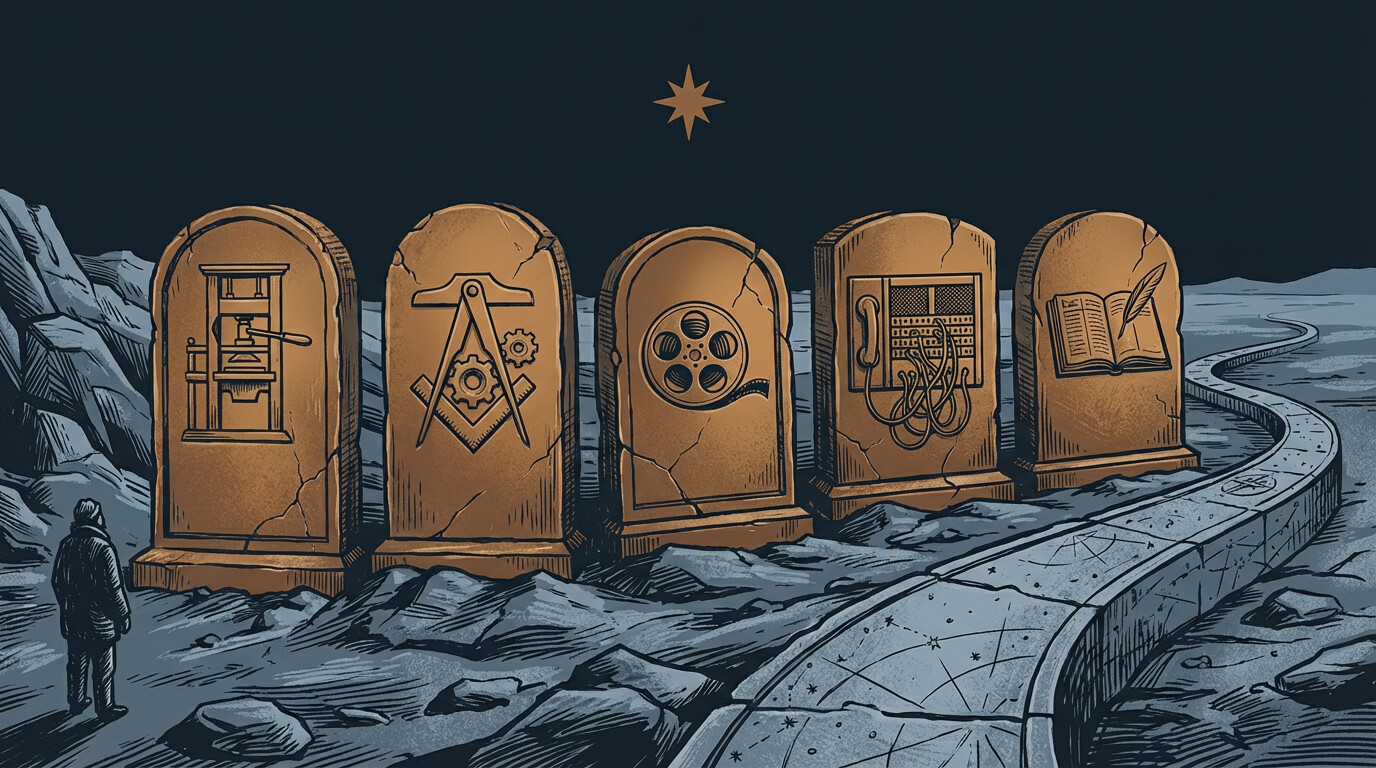
Structured from 16 historical case studies and a cross-case synthesis across the historical precedent research lens. Source-reviewed, fact-reviewed, and gap-reviewed before publication.
Every profession that has faced what software developers face now left survivors and casualties. Typesetters. Drafters. Bookkeepers. Bank tellers. Travel agents. Factory workers. Darkroom technicians. Switchboard operators. Longshoremen. The list runs to sixteen cases spanning 150 years, and the research behind this piece examined all of them — their timelines, their displacement patterns, who adapted and who didn’t, what institutions did and didn’t do, and how long the whole thing took.
The dividing line between survivors and casualties was never the technology. It was the same line every time.
The line
In the 1980s, roughly 4,000 typesetting firms operated across North America. The International Typographical Union — the oldest continuously operating union in the United States — peaked at 121,858 members. These were skilled craftspeople working a trade that stretched back to Gutenberg. They set type in molten lead at 535 degrees Fahrenheit. They knew kerning, leading, font pairing, visual hierarchy. They operated machines that cost hundreds of thousands of dollars.
Then, in 1985, Aldus PageMaker shipped for the Macintosh. A few thousand dollars of equipment could now replicate what had required years of training and specialized machinery. By 1987, ITU membership had halved in three years. By 1995, the overwhelming majority of those 4,000 typesetting firms had ceased to exist. Desktop publishing consolidated 15 to 20 specialist roles — typesetter, paste-up artist, camera operator, color separator, film stripper — into one generalist graphic designer at a computer.
But not every typesetter was destroyed. The ones who understood typography — why Garamond works for body text, how visual hierarchy guides the eye, what makes a page readable — carried that knowledge into desktop publishing. The ones who understood how to operate a Linotype machine did not. Chris Carlsson, a San Francisco typesetter, survived by learning the new tools; by 1994, his old equipment was displayed as a “Monument to Obsolete Technology and Useless Skills” in a public art installation. He kept working. The equipment didn’t matter. What he knew about typography did.
The same split appeared in every case studied.
When spreadsheet software arrived in 1979, it automated the core mechanical task of bookkeeping — manually computing, cross-adding, and re-adding columns of figures. Approximately 400,000 bookkeeping clerk positions disappeared over the following two decades. But accountants who understood what the numbers meant — who could interpret results, build financial models, advise clients — saw their profession expand dramatically. Tim Harford reported in the Financial Times that BLS data showed roughly 339,000 accountants and accounting clerks in 1980, rising to 1.4 million accountants and auditors by 2022. The classifications aren’t directly comparable, but the trajectory is unmistakable. As Harford observed: “There are more accountants than ever; they are merely outsourcing the arithmetic to the machine.”
When AutoCAD shipped in 1982, manual drafting skill — precise pencil work, lettering, ink technique, T-square manipulation — became worthless. But engineering knowledge retained full value. The BLS notes explicitly that CAD and BIM technologies now allow engineers and architects to perform tasks that used to require dedicated drafters. The drafter occupation wasn’t eliminated — it was absorbed. Engineers did their own drafting. The standalone drafter role shrank to roughly 192,100 positions with flat growth projections, while the volume of technical drawings produced increased enormously.
Bank tellers who understood relationship banking adapted when ATMs automated cash handling. Travel agents who understood complex itineraries and high-stakes logistics survived when Expedia killed commodity bookings. Darkroom technicians who understood photographic composition adapted when digital cameras rendered film processing obsolete — even as one-hour photo shops declined 94% between 1998 and 2013. Factory workers in regulated industries — nuclear, aerospace — retained positions while assembly-line dexterity lost all value.
The dividing line was always the same: the people who understood the domain survived; the people who merely operated the tools did not. Know why the work matters, and you carry something through the disruption. Know only how to perform the task, and you compete against a machine that performs it cheaper.
Across all sixteen cases, this was the single most consistent finding in 150 years of evidence.
The speed variable
The bifurcation pattern is reassuring in one dimension — professions split but don’t disappear. The less reassuring finding is that speed determines whether the split is navigable or catastrophic.
Agricultural mechanization displaced 90% of the American farming workforce. But it took sixty years, allowing generational self-selection — children chose different careers rather than parents being forced out of theirs. Switchboard operator displacement took sixty to ninety years, partly because AT&T — a monopoly employer — deliberately chose to go slow. The company viewed human operators as central to service quality and managed the pace of automation through natural attrition rather than mass layoffs.
Typesetter displacement took ten years. The ITU, which had thrived for eight decades as technology expanded the pie (the Linotype machine actually grew the union by making typesetting cheaper and demand larger), was annihilated when desktop publishing didn’t just automate their task but made the specialist unnecessary entirely. The 1962-63 New York newspaper strike — 114 days, seven newspapers shut down — bought time but accelerated the industry’s decline. Four of those papers eventually ceased independent publication. In 1986 at Wapping, Rupert Murdoch fired 6,000 print workers overnight when they struck against computerization. Approximately 5,000 lost their jobs permanently.
The consistent finding across the research: disruptions slower than roughly twenty years allow generational adaptation — the transition is painful but absorbable. Faster disruptions force individual career reinvention, which produces dramatically worse outcomes for incumbents.
The IT offshoring wave — the most directly relevant precedent for developers — unfolded over roughly ten to fifteen years from the Y2K catalyst in 1998 to market normalization around 2010-2012, with the sharpest disruption concentrated in a five-to-six-year window between 2001 and 2006. It produced the BLS data point I cited in “The Bifurcation”: computer programmer employment fell from over 700,000 to 121,200 while software developer employment grew with 15% projected growth through 2034. Same industry. Same decades. The occupation rooted in understanding systems grew. The one rooted in operating them collapsed.
The workers who thrived through offshoring were those who moved up the abstraction stack — from writing code to designing systems, from implementation to architecture, from technical execution to client-facing problem solving. Domain specialists embedded in specific industries — healthcare, finance, government — where deep contextual knowledge couldn’t be transferred offshore were insulated from displacement.
The workers who suffered most were those whose primary value was routine coding to specification — well-defined programming tasks with clear acceptance criteria. Exactly what offshored well. Older workers and those with narrow technical specializations fared worst. And the institutional response — the federal Trade Adjustment Assistance program — initially excluded IT workers entirely because software wasn’t classified as a “tangible good.” It took until 2009 for Congress to extend eligibility, by which point the sharpest displacement was over.
Even when TAA was available, the results were discouraging. Brookings found that participants had lower employment in the first years after layoffs compared to similar workers not in the program. Reynolds & Palatucci (2012) found that participating in TAA caused a wage loss approximately ten percentage points greater than not participating. The most effective retraining program in the federal government’s toolkit produced outcomes worse than doing nothing at all.
The Jevons question
Before I get to where the current pattern diverges from history — and it does, in ways that matter — there’s an important question the historical evidence raises without resolving.
In several cases, the disrupting technology made the activity cheaper, which expanded demand enough to sustain or even grow employment. Economists call this the Jevons paradox, after William Stanley Jevons, who observed in 1865 that more efficient steam engines didn’t reduce coal consumption — they increased it.
The bookkeeper case is the strongest optimistic precedent. Spreadsheets automated arithmetic, which revealed enormous latent demand for financial analysis. The profession didn’t shrink; it exploded. VisiCalc didn’t just speed up existing accounting work — it made entirely new categories of analysis economically feasible. Scenario modeling, what-if analysis, complex financial instruments — these barely existed before electronic spreadsheets made them affordable. The financial analyst profession grew from near-nothing to a major occupational category within two decades.
Bank tellers experienced the same effect — temporarily. ATMs reduced the cost of operating a branch by cutting tellers per branch from about twenty to thirteen, which led banks to open 43% more urban branches. More branches times fewer tellers per branch still equaled more total tellers. Teller employment grew from roughly 250,000 in 1970 to 545,000 by 2007.
Then mobile banking arrived. ATMs had automated some teller tasks while keeping the branch visit necessary. Mobile banking made the branch visit optional. When the technology graduated from reducing the cost of the activity to eliminating the need for it, the Jevons effect collapsed. Teller employment has since fallen roughly 36% from its peak, with BLS projecting a further 13% decline through 2034.
A 1989 IEEE study found that CAD adoption initially increased drafter employment in aerospace and automobile manufacturing — making it economical to produce far more technical drawings per project. But the Jevons effect proved temporary there too. Long-term drafter employment declined as engineers absorbed the work.
The critical question for software developers: is AI currently making development cheaper (Jevons applies, demand expands) or making developers optional for expanding categories of work (Jevons collapses)?
The honest answer from the historical evidence: both outcomes are plausible, and which one dominates depends on whether software demand is more like financial analysis — nearly universal, deeply elastic — or more like engineering drawings — large but ultimately bounded. Daron Acemoglu and Pascual Restrepo’s peer-reviewed framework on automation and new tasks cautions that the “reinstatement effect” — automation creating enough new tasks to offset displacement — has been weaker than the displacement effect over the past three decades, and that “so-so automation” can produce real productivity gains insufficient to stimulate demand expansion that offsets job losses. The bookkeeper case may have been unusually favorable. It is not guaranteed to repeat.
Where the pattern breaks
Sixteen cases is enough to identify a pattern. It’s also enough to see where the current disruption diverges from all of them — in ways that cut against the reassuring reading.
AI improves. Historical substitutes plateaued. Offshore workers had fixed capability ceilings — coordination overhead, language barriers, cultural gaps that reduced theoretical 80-90% savings to roughly 50% net. ATMs could dispense cash but couldn’t advise. Desktop publishing replicated typesetting output but didn’t keep getting better at it. AI capabilities are on a steep improvement curve with no clear plateau. The escape hatch that worked for IT offshoring survivors — moving from coding to architecture — is a correct current strategy, but unlike offshoring, where the safe zone at the top of the abstraction stack was stable, AI is progressively encroaching on architectural and design work. The threshold of irreducible human complexity is a moving target, not a fixed destination.
No one is managing the pace of adoption. In every historical case where displacement unfolded slowly enough to absorb, a coordinating institution controlled the tempo. AT&T chose to automate gradually. The longshoremen’s unions negotiated managed displacement in exchange for financial protections. Agricultural mechanization had decades of institutional development — the Extension Service, land-grant universities, the GI Bill. Software development has no equivalent brake. The companies building the AI tools are the same ones accelerating their adoption, each optimizing for competitive advantage. The aggregate effect is uncoordinated displacement at market speed.
The “move up the stack” escape hatch is shrinking. In every historical case, there was a judgment layer above the automated task that the technology couldn’t reach. Bookkeepers moved into financial analysis. Drafters became engineers. Travel agents became luxury advisors. IT workers moved from coding to architecture. This “move upstream” strategy has been the most reliable survival pattern across 150 years of precedent. But no historical case featured a disrupting technology that simultaneously automated the execution layer and progressively encroached on the judgment layer. Current LLMs handle standard architectural patterns for common systems. The safe zone exists, but it’s not static — it’s contracting. The correct strategy is still to move upstream. The new reality is that upstream is a moving target.
The quality feedback loop is weaker. Call center offshoring self-corrected partially because customers experienced poor service immediately — a twenty-one-point satisfaction gap that was visible and measurable. Factory product quality problems were visible to buyers. AI-generated code quality problems are internal — technical debt, subtle bugs, architectural degradation — and may surface only months or years later. The self-correcting mechanism that moderated call center and manufacturing offshoring will operate much more slowly for AI-generated code, meaning the displacement may proceed further before quality concerns create pushback.
Entry-level positions are the first casualty — again. This is the single most universal pattern across all sixteen cases. In managed displacement, the longshoremen’s hiring register was frozen for thirteen years — an entire generation excluded. In IT offshoring, entry-level coding jobs moved offshore first. In photography, minilab positions disappeared entirely. In the COVID correction, entry-level tech postings dropped roughly 67%. The historical pattern is unambiguous: entry-level positions are eliminated first because they sit closest to the commodity layer. And their elimination removes the career ladder that mid-level and senior workers used to reach their current positions. If you close the door behind you, eventually there’s no one coming up.
What the gravedigger knows
Across all sixteen cases, five factors consistently predicted who survived:
Depth of domain knowledge over breadth of tool proficiency. In every case, workers whose value was rooted in understanding a domain — engineering, finance, medicine, photography, travel — fared better than those whose value was rooted in operating a tool. This was the single strongest predictor. A developer whose primary skill is “can write Python” occupies the same structural position as a drafter whose primary skill was “can draw straight lines.”
Early adoption of the disrupting technology. Typesetters who learned desktop publishing early, accountants who embraced VisiCalc, travel agents who used online tools rather than competing against them, drafters who learned CAD, photographers who learned Photoshop — all gained advantage during the transition period when both old and new skills were scarce. Resistance consistently accelerated rather than prevented displacement. The ITU’s strikes killed newspapers. The Wapping strikers were fired overnight. The ILA’s 2024-25 automation ban bought temporary delay but is explicitly temporary, expiring in 2030.
Movement upstream in the value chain. Workers who shifted from execution to design, from production to judgment, from implementation to architecture consistently thrived. The BLS programmer-to-developer split is the clearest statistical evidence: the coding role collapsed; the design role grew. The bookkeeper-to-financial-analyst transition is the same pattern. The drafter-to-engineer absorption is the same pattern.
Client relationships and institutional embeddedness. Workers whose value was relational — client trust, organizational context, stakeholder understanding — were protected longer than those whose value was purely technical. Travel agents with loyal high-net-worth clients survived. IT workers embedded in specific industries survived offshoring. Journalists with personal brands and direct audiences survived the print collapse. The value was in the relationship, not the output.
Self-direction. This is the finding that stings. Government retraining programs performed poorly across nearly every case. TAA participants fared worse than non-participants. The JTPA showed no statistically significant improvement. Corporate retraining promises — companies that offshored rarely invested in retraining displaced domestic workers; the savings went to shareholders and consumers. The single documented success in the entire dataset is Sweden’s job security councils, which achieved 90% reemployment — and they require employer-funded institutional infrastructure that does not exist in the US tech sector. The most effective transition mechanism Brookings identified was on-the-job learning in a new role, which requires getting the new role first. That’s not a program. That’s the challenge itself.
What the pattern demands
The historical evidence does not predict the future. It identifies patterns, and patterns break. But the consistency of the finding across 150 years and sixteen independent cases earns serious weight.
The profession is bifurcating — not declining, not dying, but splitting along a line that the historical record makes legible: those who understand why systems exist and what they serve carry something durable through disruption, and those whose value is the act of building to specification compete against a tool that does it cheaper. In 150 years of evidence, that competition has never ended well for the human.
The speed matters. Offshoring gave workers a decade. The typesetter wipeout took ten years. AI deploys at software speed with near-zero marginal cost and no coordination tax. The adaptation window is likely compressed, though exactly how compressed remains genuinely uncertain. What is not uncertain is that waiting for the old market to return has never worked in any of the sixteen cases studied. The market that replaced the old one rewarded a different set of skills every time.
And the institutions that might manage the transition — government retraining programs, employer-funded upskilling, union-negotiated protections — have an unbroken record of arriving late, targeting poorly, and sometimes making outcomes worse. The most effective government retraining program in the historical record produced results worse than doing nothing. Sweden’s model works, but it requires infrastructure America doesn’t have and isn’t building. The evidence says: if you’re waiting for institutional help, you’re the typesetter counting on the ITU.
The uncomfortable corollary: the people most at risk — junior developers, early-career workers whose entry-level roles are being eliminated first — are also the people with the least leverage to act on these findings. This is not a moral observation. It’s a structural one, visible in every historical case from the longshoremen’s thirteen-year hiring freeze to the IT offshoring wave’s entry-level-first displacement pattern. The career ladder is being cut from the bottom. Senior developers still standing on it should understand what that means for the profession downstream.
The evidence is not comfortable. It is clear.